The Vintage Look
His photogravures are a symbiosis of classic etching and photography. Each print on the copperplate paper is unique. The application of the copperplate oil colour, the rubbing of the etching plate with gauze and the printing on the etching press are carried out by hand for each print, just as with copperplate engraving.
Ralph began his first experiments in photogravure after reading an article in a trade journal about the New York photographer Peter Liepke, which aroused his curiosity. Peter Liepke first produced platinum/palladium prints or gum prints from his New York photographs, and then had a ‘Special Photogravure Edition’ printed on the etching press.
As a photographer, Ralph had already been working exclusively digitally for many years. However, he did not want to return to the analogue darkroom with all its photochemistry. The classic heliogravure process, in which a photographic motif is etched into the copper plate using acid, was also out of the question for him. So he looked for a way to combine his photography with photogravure. In the process, Ralph became aware of the still very new technique of photopolymer gravure printing. It took him a year and many experiments before he was able to print the first light etching the way he wanted it. The artist learnt intaglio printing with copper plate, oil paint and etching press from the artist and printmaker Sven Wohlgemuth in Hamburg.
Photography forms the starting point for photogravure. All the motifs are his own photographs, into which he has poured his extensive experience as a photographer and a lifelong passion for black-and-white photography. Photography involves a rigorous conceptual selection process, in which he anticipates the conversion into a black-and-white image and the subsequent printing process; consequently, only a very small number of expressive compositions make it into the photogravure. Each photogravure is created from a single analogue or digital image without any form of digital image manipulation, HDR, CGI or AI.
The intaglio etching technique is a form of ‘non-toxic intaglio printmaking’: rather than etching directly into the copper plate with toxic acid, as in heliogravure, a light-sensitive, soft photopolymer layer is applied to the plate using a squeegee. Once dry, the printing plate is ready for exposure to the motif. The motif, which has previously been transferred onto a transparent film, is then burned into the light-sensitive layer using light. Ink on the template blocks the light, and the photopolymer remains soft in those areas. These unexposed soft areas are dissolved away in a soda bath, and intaglio oil ink is rubbed into these recesses. To expose the plate, Ralph uses a contact copier from the analogue era, manufactured by Theimer in the 1980s. This device incorporates a 1000-watt UV lamp and a heavy vacuum frame.
Before the intaglio plate can be rubbed with the oil colour, the soft unexposed polymer must be removed from the plate. To do this, the exposed plate is briefly placed in a bowl of washing suds or washing soda. The alkaline soda dissolves the soft polymer out of the wells. After a short intermediate soaking, the polymer layer with the indentations is fixed and hardened in an acidic vinegar bath.
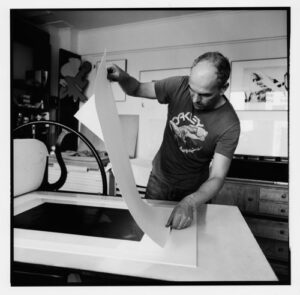
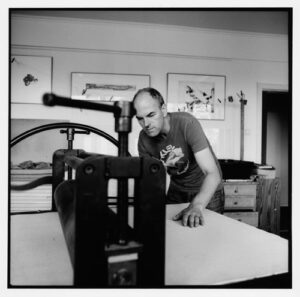
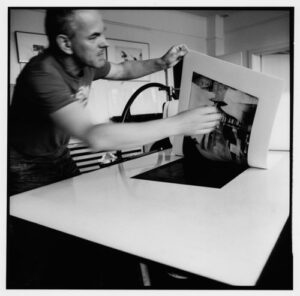
The subsequent print on paper is identical to the traditional copperplate engraving and the classic etching. The printing plate is rubbed with oil colour and carefully wiped out by hand in many passes with wiping gauze until the oil colour is only in the indentations. Once the plate is ready for printing, it is placed on the printing table of the etching press. A damp copperplate paper is carefully placed over it, the whole thing is covered with a printing felt and together the printing plate and copperplate paper are moved through the rollers of the etching press using a large flywheel. The pressure of the steel rollers, which weighs several tonnes, the moisture in the copper printing paper and the felt mat transfer the oil-based ink from the indentations in the printing plate to the paper. The print is complete. For each additional print, the printing plate is rubbed again with oil colour and wiped with gauze.
As the indentations are not etched into the copper plate with acid as with heliogravure, but are exposed in the photopolymer layer above it, the copper plate can be reused for other motifs after the edition has been printed. The photopolymer is removed from the copper plate by soaking it for a long time in a bath of washing suds.
Ralph uses a copperplate paper from Hahnemühle for his intaglio prints. The genuine mould-made paper for artistic printing techniques is produced in individual sheets on a cylinder mould paper machine. It is acid-free and resistant to ageing. All etchings are original prints made by the artist himself.
Share the page with others
Mobile:
Fone:
Email: